I have tried on more than one occasion to make polymer clay cabochons. This is my latest attempt.
I finally, finally after what feels like a bazillion tries got a nice shiny surface! I really took my time with these and spent a lot of time getting the surface nice and smooth. Then, I used rubbing alcohol to smooth the surface even more before curing. After they cooled, I sanded them with progressively finer grits of sand paper (320 to 1000) and buffed them with my Dremel.
Here is one of the cabochons being used for a bead embroidered pendant.
I'm still pondering how exactly I want to finish this off.
Next plan is to make cabochons with the polymer clay version of "mokume gane". I've failed spectacularly at that technique repeatedly. (Mokume gane is a Japanese metal working technique that emulates wood grain).
Hopefully, I've figured out my problems and can make some nice polymer clay mokume gane cabochons (in Christmas colors. . . ). And, I want to see if I can get an even shinier surface by sanding down to 2000 grit.
Tuesday, July 26, 2011
Tuesday, July 19, 2011
ArtFire Avatar - Done!
I finally finished the picture for my ArtFire avatar. I'm not completely happy with it, but I'm going with it anyway.
Here's what it looks like small size, reversed with a black background:
I think I should have done something less detailed for the small size. Maybe I'll work on it more later, but for now, I need to move on.
Here is a little preview of what my new ArtFire shop is going to look like:
I like how the new cleaner look. Looks more up-to-date. However, I'm not real keen on the avatar box hovering over the banner. But, I'll just have to live with it.
I don't know when the ArtFire changes will go live. Couple of weeks ago they said it would be 2-4 weeks. So I would imagine it will be a couple more weeks at least.
Here's what it looks like small size, reversed with a black background:
I think I should have done something less detailed for the small size. Maybe I'll work on it more later, but for now, I need to move on.
Here is a little preview of what my new ArtFire shop is going to look like:
I like how the new cleaner look. Looks more up-to-date. However, I'm not real keen on the avatar box hovering over the banner. But, I'll just have to live with it.
I don't know when the ArtFire changes will go live. Couple of weeks ago they said it would be 2-4 weeks. So I would imagine it will be a couple more weeks at least.
Monday, July 18, 2011
VA Beach Quilter - Guild Featured Artist
Featured this week by the ArtFire guild, "Shops With Less than 10 Sales", is VA Beach Quilter. Kim, the shop's owner is also guild master for this awesome guild! Her studio/shop is full of wonderful hand crafted goodies! Guaranteed to find something for everyone!
This month, Kim is having a Christmas in July sale -15% off your total purchase with the coupon: XMAS2011
She has several beautiful quilts in traditional patterns including this log cabin quilt featuring Civil War reproduction fabrics. I'm partial to quilts and they are my favorite items in her shop!
There are numerous items for sports fans including this Pittsburgh Steelers table topper. Wouldn't this be great for fall football parties? Not a Steelers fan? Contact her for a custom order featuring your favorite team.
The fabric for this Kindle/Nook case is so pretty! Kim has an incredible variety of Note keepers, coupon organizers, bags checkbook covers, etc. And she has so many lovely fabrics!
Kim also has a lovely fabric "destash" shop, "VA Beach Quilter Destash", and pattern/book "destash" shop, "Quilter Bee"
And be sure to check out the "Shops With Less Than (10)" blog, for more information about "VA Beach Quilter". And while you are there leave a comment to enter a chance to win the monthly giveaway. This months prize is a cute pair of earrings from Keri Mae.
This month, Kim is having a Christmas in July sale -15% off your total purchase with the coupon: XMAS2011
She has several beautiful quilts in traditional patterns including this log cabin quilt featuring Civil War reproduction fabrics. I'm partial to quilts and they are my favorite items in her shop!
| Civil War Log Cabin Quilt |
| Pittsburgh Steelers Table Topper |
The fabric for this Kindle/Nook case is so pretty! Kim has an incredible variety of Note keepers, coupon organizers, bags checkbook covers, etc. And she has so many lovely fabrics!
| Dragonfly Kindle/Nook Case |
Kim also has a lovely fabric "destash" shop, "VA Beach Quilter Destash", and pattern/book "destash" shop, "Quilter Bee"
And be sure to check out the "Shops With Less Than (10)" blog, for more information about "VA Beach Quilter". And while you are there leave a comment to enter a chance to win the monthly giveaway. This months prize is a cute pair of earrings from Keri Mae.
Sunday, July 17, 2011
Exploring seed beads
For the past couple of weeks I've been trying to expand my "beading horizons" so to speak. I tried some new (to me) things with seed beads. This first bracelet utilizes a "Cellini spiral" technique which is based on "peyote spiral" stitch. I like how it turned out, but the beading on this was a little tedious.
I used a product called "FireLine" for the beading thread. It is actually fishing line and is used a lot in beadwork. This was my first time using it. It comes in two colors, clear and smoke. I used clear, and the thread shows quite a bit in this bracelet.
The next bead experiment is this "waterfall" necklace. I absolutely love how this turned out and it was so much fun to make! I plan to make more.
The instructions for this necklace are on a YouTube video by tsummerlee. At the end of her video she shows some of her necklaces and they are absolutely gorgeous!
Last item is a bracelet I made based on a tutorial in a Beadwork magazine from a couple of years ago. I like how it turned out, except but you can see the thread in some places (although you can't see it in the picture). I would like to make some variations of this, but it bugs me how much the thread shows.
I have some other beading projects I have in mind to try out. I'm also hoping to work on some polymer clay this week. Gardening and canning really got me sidetracked! Also, there are lots of changes that will be happening at ArtFire, and I really need to get serious about working on my studio/shop!
I used a product called "FireLine" for the beading thread. It is actually fishing line and is used a lot in beadwork. This was my first time using it. It comes in two colors, clear and smoke. I used clear, and the thread shows quite a bit in this bracelet.
The next bead experiment is this "waterfall" necklace. I absolutely love how this turned out and it was so much fun to make! I plan to make more.
The instructions for this necklace are on a YouTube video by tsummerlee. At the end of her video she shows some of her necklaces and they are absolutely gorgeous!
Last item is a bracelet I made based on a tutorial in a Beadwork magazine from a couple of years ago. I like how it turned out, except but you can see the thread in some places (although you can't see it in the picture). I would like to make some variations of this, but it bugs me how much the thread shows.
I have some other beading projects I have in mind to try out. I'm also hoping to work on some polymer clay this week. Gardening and canning really got me sidetracked! Also, there are lots of changes that will be happening at ArtFire, and I really need to get serious about working on my studio/shop!
Labels:
bead weaving,
Celini spiral,
seed beads
Saturday, July 16, 2011
More Cherries -Adventures in Canning
Over the 4th of July weekend (I know, I'm a little slow updating the blog) we picked more cherries - 65 pounds!
We picked Rainiers and Bings, although the Bings were few and far betweeen.
I spent two days pitting (did have help with that) and canning. Cherries are my least favorite canning project, but they are so good!
I have two different style cherry pitters. With the one pictured, you hit the plunger with the palm of your hand and it impales the cherry and pushes the pit out. Pretty cool, except it doesn't work all that well and doesn't always take out the pits. And it totally failed on the huge Rainiers. Ended up having to use my hand pitter (looks like funny plyers) for most of the pitting.
The recipe I used to can them is here: Canned cherries
Last year I canned only bings and did not pretreat to prevent browning. I think they are so dark, it doesn't matter. Rainiers on the other hand, are light colored and would turn an icky brown if not treated.
**Note, pretreating for browning is a quality issue and not a safety issue. Not treating would make for an unappetizing looking product. If processed PROPERLY, it would be safe to eat. Not processing for the prescribed amount of time would be a SAFETY issue.
I used one of my 5 gallon buckets to pretreat the cherries. I think this is a mix of Bings and Rainiers in the picture.
Cherries do not have to be pitted to be canned, but we prefer them pitted.
I opted to use a light syrup 20% sugar, 80% water to can the cherries. I used 4 1/2 water and 1 1/8 cups sugar (half the recipe for 7 quarts).
Next choice, is hot pack vs. cold pack and I opted for hot pack. Again, personal preference. Hot pack is a little more work (but not that much compared to the task of pitting the cherries). With the hot pack method, the fruit doesn't float so much in the jar.
Here's the final product! I ended up with21 20 pints of canned cherries, several freezer containers of cherries, 11 half-pints of cherry jam, 7 quarts of pie topping, a jar of dried cherries and 2 desserts.
One pint of the cherries didn't seal and I didn't notice it until the next day. However, it was within 24 hour, so it was okay and it ended up in our oatmeal.
We picked Rainiers and Bings, although the Bings were few and far betweeen.
I spent two days pitting (did have help with that) and canning. Cherries are my least favorite canning project, but they are so good!
I have two different style cherry pitters. With the one pictured, you hit the plunger with the palm of your hand and it impales the cherry and pushes the pit out. Pretty cool, except it doesn't work all that well and doesn't always take out the pits. And it totally failed on the huge Rainiers. Ended up having to use my hand pitter (looks like funny plyers) for most of the pitting.
The recipe I used to can them is here: Canned cherries
An average of 17½ pounds is needed per canner load of 7 quarts; an average of 11 pounds is needed per canner load of 9 pints.My canner only holds 7 pints - so I figured 8 3/4 pounds for 7 pints (half of 7 quarts).
Stem and wash cherries. Remove pits if desired. If pitted, place cherries in water containing ascorbic acid to prevent stem-end discoloration.I forgot to purchase ascorbic acid for this project (available around here at the local health food store and the local beer/wine making supply shop). Instead I used vitamin C tablets at the rate of six, 500 mg tablets per gallon. I used a mortar and pestle to crush them.
Last year I canned only bings and did not pretreat to prevent browning. I think they are so dark, it doesn't matter. Rainiers on the other hand, are light colored and would turn an icky brown if not treated.
**Note, pretreating for browning is a quality issue and not a safety issue. Not treating would make for an unappetizing looking product. If processed PROPERLY, it would be safe to eat. Not processing for the prescribed amount of time would be a SAFETY issue.
I used one of my 5 gallon buckets to pretreat the cherries. I think this is a mix of Bings and Rainiers in the picture.
Cherries do not have to be pitted to be canned, but we prefer them pitted.
If canned unpitted, prick skins on opposite sides with a clean needle to prevent splitting.
I opted to use a light syrup 20% sugar, 80% water to can the cherries. I used 4 1/2 water and 1 1/8 cups sugar (half the recipe for 7 quarts).
Cherries may be canned in water, apple juice, white-grape juice, or syrup. If syrup is desired, select and prepare preferred type as directed.Besides adding sweetness, sugar helps retain color and texture. The use of sugar (or not) is a quality and personal preference issue, not a safety issue.
Next choice, is hot pack vs. cold pack and I opted for hot pack. Again, personal preference. Hot pack is a little more work (but not that much compared to the task of pitting the cherries). With the hot pack method, the fruit doesn't float so much in the jar.
Hot Pack - In a large saucepan add ½ cup water, juice, or syrup for each quart of drained fruit and bring to boil. Fill jars with cherries and cooking liquid, leaving ½-inch headspace.
Cold Pack - Add ½ cup hot water, juice, or syrup to each jar. Fill jars with drained cherries, shaking down gently as you fill. Add more hot liquid, leaving ½-inch headspace. Adjust lids and process.Processing time for hot vs. cold are different. I processed the hot packed pints in a boiling water bath for 15 minutes (for an elevation of 0-1000 feet). Cold pack processing time for pints at 0-1000 feet is 25 minutes. Always check the processing time!
Here's the final product! I ended up with
One pint of the cherries didn't seal and I didn't notice it until the next day. However, it was within 24 hour, so it was okay and it ended up in our oatmeal.
If a lid fails to seal on a jar, remove the lid and check the jar-sealing surface for tiny nicks. If necessary, change the jar, add a new, properly prepared lid, and reprocess within 24 hours using the same processing time. Headspace in unsealed jars may be adjusted to 1-½ inches and jars could be frozen instead of reprocessed. Foods in single unsealed jars could be stored in the refrigerator and consumed within several days.It may take me a few more days to find my canning mojo - in the mean time I other things to catch up on (besides house cleaning, blech).
Saturday, July 2, 2011
New Banner
Finally, I think I'm done. This darn banner has been making me crazy(er)! I finished the artwork for it last night and scanned it in. I've spent way too much time on this. Seriously, WAY TOO MUCH TIME!!!
Unfortunately, there is a lot of detail in the lettering that gets lost when sizing down for the banner. I had to do some serious Photoshop editing, which was pretty traumatic. I think I might of caused my daughter a "World of Warcraft" death or two with my non-stop Photoshop questions!
I still need to work on an avatar - this is the one I originally created. I like it, but it is not working as an avatar. The fine details look awful when shrunk down to avatar size. Also, the colors aren't as intense as the ones in the banner.
I've been working on this banner and avatar forever! I'm wanting to upgrade and revamp my ArtFire studio/shop . Well, they are making some changes that forced me to finish this up. So, it 2-4 weeks, my ArtFire shop will have a brand spanking new look! But, for now my blog has the new banner.
One other thing, we picked more cherries today - 65 pounds! So, I may be busy canning the next couple of days. . .
Unfortunately, there is a lot of detail in the lettering that gets lost when sizing down for the banner. I had to do some serious Photoshop editing, which was pretty traumatic. I think I might of caused my daughter a "World of Warcraft" death or two with my non-stop Photoshop questions!
I still need to work on an avatar - this is the one I originally created. I like it, but it is not working as an avatar. The fine details look awful when shrunk down to avatar size. Also, the colors aren't as intense as the ones in the banner.
I've been working on this banner and avatar forever! I'm wanting to upgrade and revamp my ArtFire studio/shop . Well, they are making some changes that forced me to finish this up. So, it 2-4 weeks, my ArtFire shop will have a brand spanking new look! But, for now my blog has the new banner.
One other thing, we picked more cherries today - 65 pounds! So, I may be busy canning the next couple of days. . .
Tuesday, June 28, 2011
Cherry Jelly - Adventures in Canning!
Woo-Hoo! I got the cherry jelly made! Fourteen jars! I would have never done this if I hadn't bought the steam juicer.
I made jelly once before years ago - pomegranate jelly. Ugh, that was an icky time consuming mess. And we didn't care all that much for it. I swore I would never make jelly again after that.
It takes a while for the steamer to juice the cherries, 1 - 1 1/2 hours. But, I didn't have to stand over the stove and fuss over it. So I worked on other things (like my "Desert Wind banner) while waiting on the steam juicer. After the juice was ready, the jelly was quick to make. Okay, I forgot to take a picture of the steam juicer set up (next time), but I got a picture washing the cherries. . .
The recipe I used is from the "Ball Complete Book Of Home Preserving". I'm using 2006 edition, which is the most current up-to-date edition.
It has the only recipe I could find for sweet cherry jelly. Most of the jelly recipes I found called for sour/pie cherries. Note, that pie cherries have more acid than sweet cherries. Because the gel process needs the right ratio of fruit, sugar, pectin and acid I couldn't just use a sour/pie cherry recipe and substitute sweet cherries. I would most likely end up with cherry syrup. So I needed to find a recipe that had added acid (lemon juice).
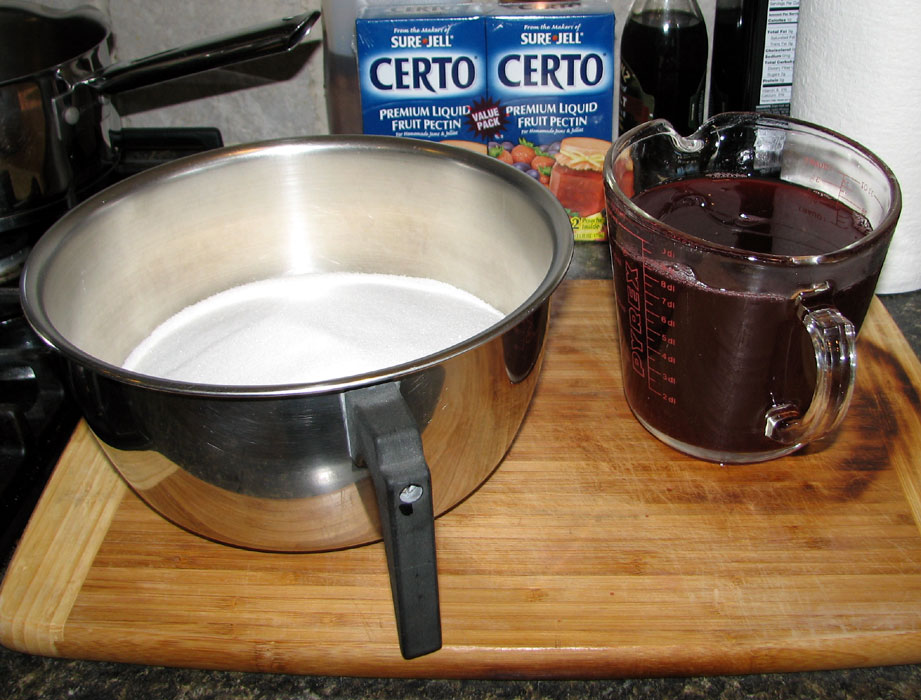
So here we have 3 1/2 cups cherry juice and 7 cups of sugar. I know, that is A LOT OF SUGAR!! Traditional jams and jellies take a lot of sugar to gel properly. (**Never really noticed this till now, but the liquid pectin recipes appear to use more sugar than the dry pectin recipes.)
There are pectins for making low sugar jams and jellies, but I have to admit, I've never used them. Maybe one of these days I will give them a try!
Okay, onward. Turned off the fire under pot and skimmed foam and saved to have later with beer bread. Note, it is perfectly acceptable to add 1/4 - 1/2 teaspoon of butter or margarine to help prevent foaming. I did add 1/4 teaspoon of butter, and it does help, but I still got a bit of foam.
I filled hot half pint jars leaving 1/4 inch headspace; wiped rims, added lids and rings. Here they are ready for their boiling water bath (BWB).
I processed in the BWB for 10 mins., per instructions.
Some important notes on processing times:
After the ten minutes were up I turned the fire off, removed the lid and waited 5 minutes before removing from the jars from the BWB. This is a fairly recent recommendation and it helps prevent liquid loss from jars.
Here is the first batch of cherry jelly waiting to be removed.
And here are two batches done!
For more detail canning and preserving information, check out this website: National Center for Home Food Preservation.
I made jelly once before years ago - pomegranate jelly. Ugh, that was an icky time consuming mess. And we didn't care all that much for it. I swore I would never make jelly again after that.
It takes a while for the steamer to juice the cherries, 1 - 1 1/2 hours. But, I didn't have to stand over the stove and fuss over it. So I worked on other things (like my "Desert Wind banner) while waiting on the steam juicer. After the juice was ready, the jelly was quick to make. Okay, I forgot to take a picture of the steam juicer set up (next time), but I got a picture washing the cherries. . .
The recipe I used is from the "Ball Complete Book Of Home Preserving". I'm using 2006 edition, which is the most current up-to-date edition.
It has the only recipe I could find for sweet cherry jelly. Most of the jelly recipes I found called for sour/pie cherries. Note, that pie cherries have more acid than sweet cherries. Because the gel process needs the right ratio of fruit, sugar, pectin and acid I couldn't just use a sour/pie cherry recipe and substitute sweet cherries. I would most likely end up with cherry syrup. So I needed to find a recipe that had added acid (lemon juice).
So here we have 3 1/2 cups cherry juice and 7 cups of sugar. I know, that is A LOT OF SUGAR!! Traditional jams and jellies take a lot of sugar to gel properly. (**Never really noticed this till now, but the liquid pectin recipes appear to use more sugar than the dry pectin recipes.)
There are pectins for making low sugar jams and jellies, but I have to admit, I've never used them. Maybe one of these days I will give them a try!
I combined the cherry juice, lemon juice and sugar then brought it to a full rolling boil. Then I fumbled with the two packets of liquid pectin, squeezed out the contents, while trying to stir and take a quick photo. . .
I'm used to the powdered pectin, where you add it first, bring to boil then add sugar. The liquid method just messes up my jam/jelly making mojo.
Boiled hard for 1 minute. Note clock with a big 'ol sweep second hand. Works perfectly for me for this! Do they still actually make clocks like this anymore?
Okay, onward. Turned off the fire under pot and skimmed foam and saved to have later with beer bread. Note, it is perfectly acceptable to add 1/4 - 1/2 teaspoon of butter or margarine to help prevent foaming. I did add 1/4 teaspoon of butter, and it does help, but I still got a bit of foam.
I filled hot half pint jars leaving 1/4 inch headspace; wiped rims, added lids and rings. Here they are ready for their boiling water bath (BWB).
I processed in the BWB for 10 mins., per instructions.
Some important notes on processing times:
- The 10 minutes stated in this recipe is for an elevation of 0-1000 feet. When canning anything, verify your elevation. For elevations over 1000 feet, adjustments to processing times need to be made for a boiling water bath.
- Always, always check your processing times using current up-to-date information.
- Also, many recipes for jams/jellies have processing times of 5 minutes. For any processing time less than 10 minutes, the jars need to be sterilized first. I prefer to just process for 10 minutes.
After the ten minutes were up I turned the fire off, removed the lid and waited 5 minutes before removing from the jars from the BWB. This is a fairly recent recommendation and it helps prevent liquid loss from jars.
Here is the first batch of cherry jelly waiting to be removed.
And here are two batches done!
For more detail canning and preserving information, check out this website: National Center for Home Food Preservation.
Subscribe to:
Posts (Atom)